
Demand for digital expertise drives up IT salaries across South Africa
Postado por Editorial em 09/02/2026 em IT SECURITYCompartilhar:




The report underscores that specialised skills, particularly in artificial intelligence (AI), cloud and cyber security, are driving recruitment activity and salary premiums.

Pnet, a leading online recruitment platform under The Stepstone Group, reports that South Africa’s growing need for advanced digital skills is fuelling sharp increases in pay for specialist technology roles.
South Africa’s IT job market is becoming increasingly competitive as companies scramble to secure scarce digital talent. According to Pnet’s Job Market Trends Report 2026: January, positions such as DevOps engineers, cybersecurity specialists, and data engineers are among the top earners in the country’s tech sector.
The report, based on data from global recruitment firm The Stepstone Group, shows that employers are offering premium salaries and flexible work policies to attract skilled professionals as digital transformation accelerates across both public and private sectors.
Data, AI, and cybersecurity expertise remain the most in-demand competencies. Job postings mentioning artificial intelligence have surged by more than 350% since 2019, highlighting how automation and data-driven decision-making are reshaping recruitment priorities.
Citing information from IT Web Africa, the research notes that Gauteng continues to dominate South Africa’s tech employment landscape, hosting the majority of well-paying roles. After last year’s hiring slowdown, flexible and hybrid work arrangements are once again on the rise, influencing compensation structures across the market.
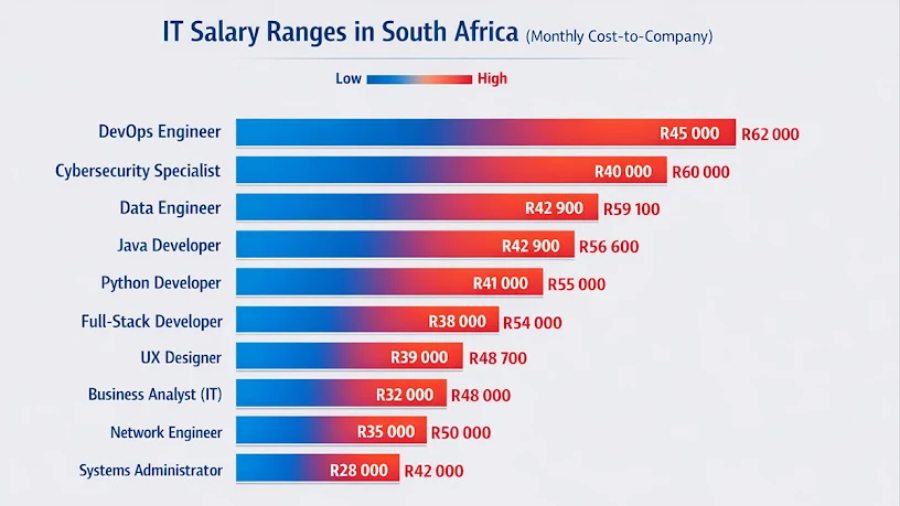
At the upper end of the scale, DevOps engineers now earn between R45,000 and R62,000 per month (cost to company), driven by strong demand for roles that oversee deployment pipelines and cloud infrastructure. Close behind are cybersecurity professionals, earning R40,000–R60,000, followed by data engineers, Java developers, and Python developers, whose salaries range between R41,000 and R59,000, depending on experience.
Even traditionally lower-profile roles such as UX designers and business analysts are seeing growth, with professionals in these categories earning R39,000–R48,000 and R32,000–R48,000, respectively. Network engineers and systems administrators also continue to command competitive pay, reflecting the ongoing need for technical infrastructure resilience.
According to Pnet, the overall picture underscores a dynamic but fragmented labour market — one where highly skilled specialists enjoy strong bargaining power, while employers struggle to find qualified candidates in emerging fields like AI, cloud services, and robotic process automation.
The rising talent gap
Despite growing investment in digital transformation, South Africa continues to face a persistent shortage of IT professionals. Pnet’s data indicates that hiring volumes in the sector have decreased by around 5% over the past three years, largely due to global tech retrenchments, yet domestic demand began to rebound sharply in late 2025.
The Institute of Information Technology Professionals South Africa (IITPSA), in its ICT Skills Survey 2024, attributes much of this gap to a mismatch between academic training and industry requirements. Graduates often lack exposure to contemporary technologies such as AI and cloud computing, while chronic shortages of STEM educators continue to slow the development of local expertise.
Gauteng remains the country’s primary source of IT professionals, accounting for nearly two-thirds of jobseekers. However, this concentration creates regional disparities, leaving smaller provinces under-resourced as national demand broadens.
“Companies are competing for a very limited pool of tech talent,” says Anja Bates, head of data at Pnet. “The current demand surge is centred around data science, AI, and automation. Organisations need these skills to innovate, improve decision-making, and remain competitive in a digital economy.”
Businesses are responding by investing heavily in upskilling and retention — including mentorship programmes, partnerships with universities, and internal training schemes. Expanding remote and hybrid work options has also helped organisations tap into a wider talent base, though uneven internet infrastructure and digital readiness remain barriers in some areas.
As the country’s economy continues its digital shift, the shortage of high-end tech skills is expected to persist, keeping salaries elevated and intensifying competition among employers seeking rare expertise in South Africa’s evolving IT ecosystem.